One of the things I’ve wanted to do for a long time is unite my love for historical inquiry with my career choice of user experience design. To this end, I wanted to do something a little bit different in terms of UX, not quite a case study where I develop my own feature but provide analysis of someone else’s. A little bit less involved, so I can do it more often.
Recently, I’ve picked up Fallout 4 again. I know that there are very large parts of the fandom that absolutely despise this game, but I enjoy it. While definitely not as deep or well-thought as Fallout: New Vegas, I think that the explorative aspects of the game are amazing. Of course, the story is an absolute mess and even I still don’t know why the Institute does anything, but there’s enough there to keep me exploring the Commonwealth.
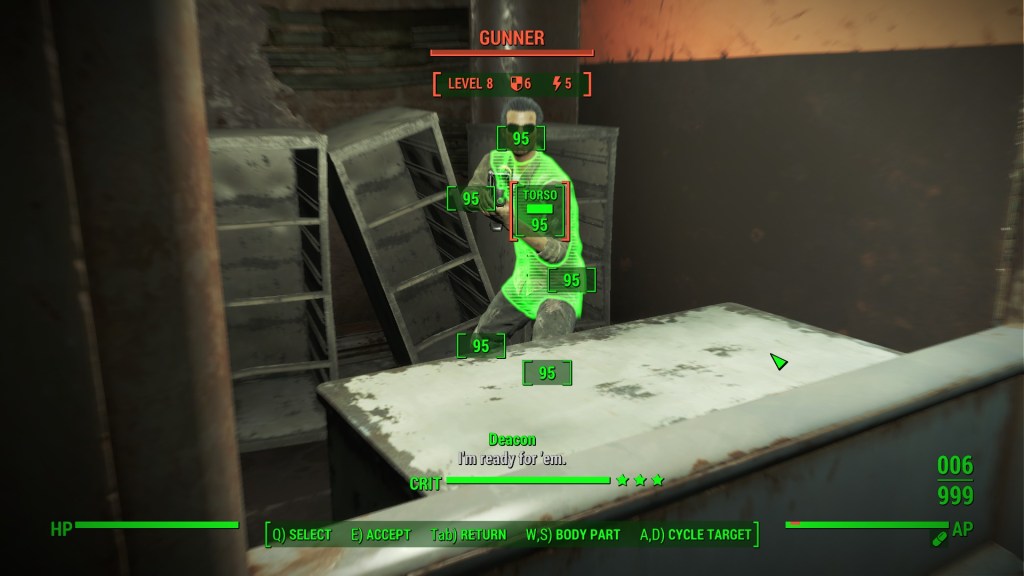
This brings me to a unique aspect of the Fallout series: the V.A.T.S system, or the Vault-Tec Assisted Targeting System. Introduced in Fallout 3, it allows players to essentially pause the game, target, and select various body parts to shoot at as seen in Figure 1. Accuracy is controlled by the player’s Perception stat, as well as other factors.
Prior to Fallout 3, the Fallout series had been a turn-based isometric role-playing game developed by Black Isle Studios and published by Interplay. This version of Fallout more resembled Dungeons & Dragons rather than the more modern version, while being groundbreaking in their own right. The voice-acting and writing are superb, particularly that one Enclave communications officer.
In 2003, the follow-up to Fallout 2, codenamed Van Buren, was cancelled. The publisher Interplay Studios had undergone financial difficulties, and this resulted in the selling of the rights to the Fallout series to Bethesda Softworks. Bethesda had been known for their own RPG series The Elder Scrolls, but were aiming to expand their repertoire. Development on this new version of Fallout 3 began sometime in 2004, and the final game was eventually released in 2008. As a whole, Fallout 3 is a reboot of the series. Detractors of this game describe it as “Oblivion with guns”, but V.A.T.S provides a bridge between the two eras of the Fallout series.
Regarding the user experience, the incorporation of the V.A.T.S. system represents a distinctive design choice that leans more towards the preferences of developers rather than being user-centered. Fundamentally, this system operates as a workaround for an inefficient shooting mechanism by providing a level of accuracy that is deemed acceptable. Upon successfully utilizing this system, players are rewarded with a slow-motion kill animation, which delivers a cinematic experience reminiscent of the bullet time sequences from the Matrix films. A simple reward, but one that encourages the player to use the reward beyond it.
 Drew Hesler