Finale Post-mortem and Successor Program
In 2024, MakeMusic announced that their proprietary music notation software, Finale, would shut down operations and end updating the software. Finale was introduced in 1988, at the tail-end of the home computer revolution, digitizing the process of writing music. Other alternatives exist, such as Dorico and Sibelius, but Finale was the first to arrive.
There were several aspects of user experience that made Finale such a useful tool, mainly its extensive depth. However, that depth came at the cost of a transparent experience. As a part of the transition away from Finale, I became interested in the features that made it unique, and the features that any successor program must have. I also consulted with some previous research by Daniel Crespo, a product designer with an interest in music. This is probably the most in-depth research on this topic to this date, and I highly recommend checking it out. This is more of a post-mortem on Finale, and provides solutions to Finale’s issues that successor software can adapt.
Finale Post-mortem
Research
So what worked about the program? The qualitative research I conducted to discover this included a phone interview with a power user with extensive experience with the program, and another power user with which I conducted a contextual inquiry. These two people have extensive experience with Finale, and provided valuable insights into the strengths and weaknesses of the software.
The first interviewer was a power user who had been using the software involved since 1994, and had been using it ever since. Amongst his observations about Finale were:
- He had started using it due to its design proximity to word processing software. As the software aged, the amount of knowledge necessary to operate the software increased
- Adored its flexibility, as you were able to tackle any use case within it. An example used was the ability to structure staves in unusual yet pleasant ways; if a user needed to structure the staves in order to write songs for Renaissance lute players, one was able to do so
- Often used alongside MIDI keyboards to input notes, integrating music technologies alongside the regular methods of input
- Frustrations were often aesthetics-related, as font choices affected layout of compositions in ways that were unexpected
The second research subject was also a power user who used the software since its original inception, and whose experience with the program was relayed to me through contextual inquiry.
- During the contextual inquiry, I got a look at the instruction manual for Finale, which was a huge physical binder, detailing every function of the program and how users can execute them.
- The task at hand involved transcribing new versions of older music copies, adjusting and correcting for readability and accuracy. Often, the user would exit the program in order to access performances of the music, listening by ear in order to produce more accurate work.
- Over 20 years of use, the user had designed his own font libraries and style books for the purposes of making the compositions readable while playing.
- User had to go into a menu to alter the set-up of the pages. This stood out to me as something to work with in terms of features, to reduce the transparency while retaining depth.
Task Analysis
For analysis of the user data I had collected, I believed that a task analysis was appropriate to discover what users needed from any successor to finale. For the task analysis, the task that I selected was the process of digitizing the Real Book in Finale, which is an unofficial collection of jazz standards written on lead sheets that was published by a group of college students in the 1960s. This was meant to be shared and bootlegged, distributed freely across thousands of musicians.
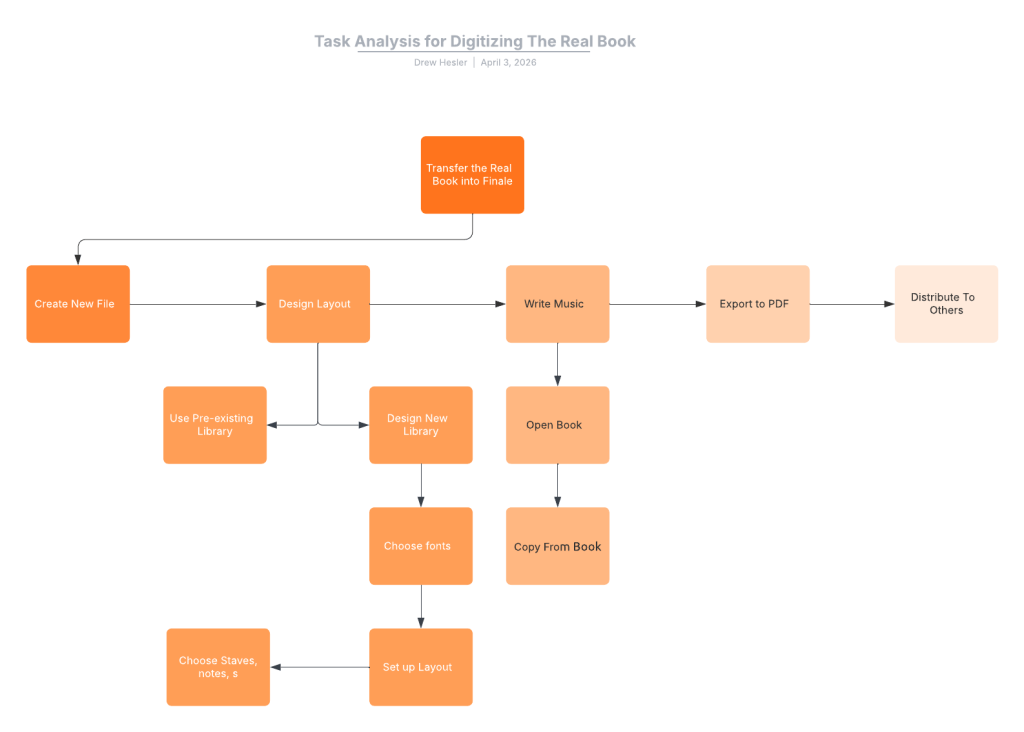
After the task analysis, it was time to design the new features necessary.
Successor Program
To retain the depth of Finale without sacrificing transparency, I developed a few additions to a sample successor program.
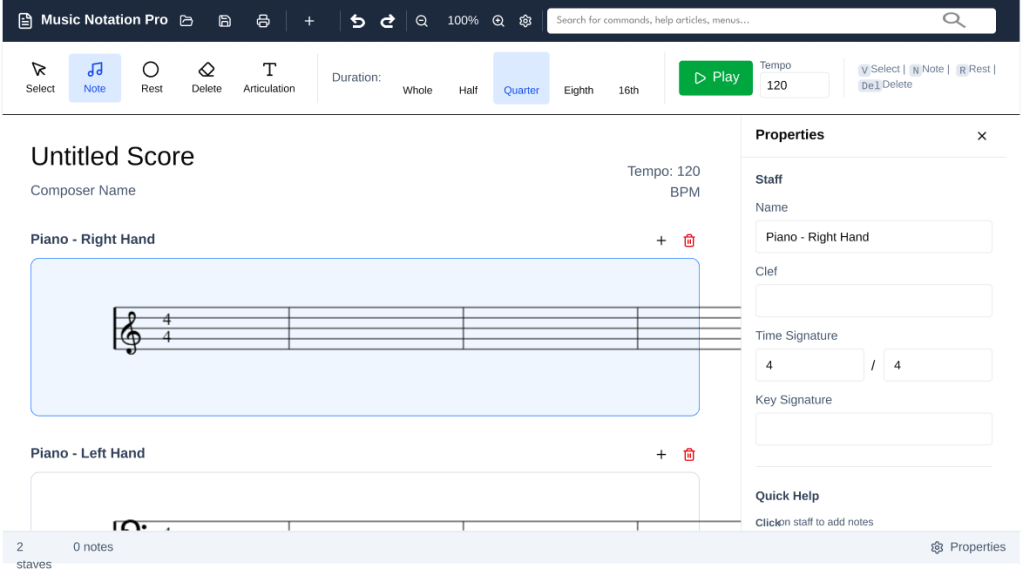
The main addition is a contextual search bar. As stated before, the actual manual for finale is a thick physical book. For 20-year-long professionals, a ton of learned shortcuts are present in the mind for which they are used constantly. Having a manual that can be searched for using natural language allows for amateurs and professionals to easily access tools that are needed, and allows near-infinite depth as any specific feature can be brought to the surface when necessary using language that anyone is familiar with.
 Drew Hesler